|
In this edition of Tips & Tricks for Magicians I'm encouraging you to get on up, get on down, and move that body alllll around. Many of the lessons from my grade ten Drama/Theatre teacher have stuck with me, but there's one which stands out as a super simple concept sorely overlooked by magicians; levels. Here's the common problem: The performer is a talking head. Barely moves away from the microphone, and when they do it's with all the grace of a warehouse worker wandering over to pick up a prop. I'm sometimes guilty of this, too. It takes a lot of work to get a magic routine to the basic ready-for-show state, and here I am talking about "next level" stuff. As I explain this, think about a routine you're already comfortable with and how you might apply this concept to make it extra-interesting. Let's start with how it was taught to me in Drama class... Three Levels on StageIt was an excercise for three people. We were given a theme, let's say "Baseball Game", and had a few seconds to organize ourselves into a tableau scene, frozen like statues. The goal was for us to all be on different physical levels; low, middle, and high. So, one person might be stretched out, leaping to catch a fly ball, the other standing at the ready to receive the throw, and the third sprawled on the floor sliding into home base. The point is that it creates an interesting visual scene, rather than three actors standing around all looking more or less identical. The same standing-around-talking problem is common in improv theatre, and they have a game to train better habits - most every improv game is created to practice a specific performance technique - called "Sit, Stand, Lie." (see it in action on the Whose Line show) At any moment one actor must be standing, another sitting, and the third laid out flat. Any one person can change their state at any moment, causing the other two to quickly take up the vacant positions. All this is going on alongside the usual story of the scene. The point is learning to move your body while performing, not just stand around. Don't just stand there, Do Something!But magicians, we like to stand around. MENTALISTS! Oh my, mentalists loooove to just stand around. The most action in many mentalism shows is when the six enveleopes get mixed. We tend to prioritize our mouths and hands as our most interesting parts, and ignore the rest. In his book The Show Is The Mother of Invention (2023) Doc Dixon is explaining how he packs small and plays big. One of his many excellent points is when he says YOU, your body, is your "best and biggest prop." Use it to its fullest potential. Be more physically interesting. Get Low - Hunch over and sneak across the stage. Hide behind a stool. Mike Caldwell's signature move was to get flat on the floor! Go High - Stretch up on your very tippy-toes reaching for the sky. Stand up on a chair. Climb a ladder. Play In The Middle - You can stand, but stand interesting. Extend your arms straight out. Lift one leg. Do something to break out of your standard position. Make Memorable MomentsI learned this lesson the best way; real audience feedback. People come up after the show and say "oh man, I loved that part when you..." I'd bump into people years later and they'll say "I still remember when you..." ... and the thing they'd talk about was not the trick. Not really. It was something about the way in which I did that trick. A special way that I made it more interesting. It all began unintentionally when I started taping a fork to my head. It was a stupid bit, really quite inconsequential to the trick, but it was a moment which stood out to the audience. So, I thought, why not do more of that. I used to call them "Kodak Moments" which, for the youts, means a moment worthy of taking a photograph. (You see, kids, once upon a time we had to be choosy about the moments worth capturing on film because it was a slow and expensive process.) The technology has changed, but the theory still holds; what moments in your act are photo-worthy? What can you do to make your actions more visually interesting? Instead of just having somebody roll a die (standard), I got a twelve-inch-cubed inflatable die, like a beachball, to throw around the audience (interesting!). I was doing a trick where I wanted the audience to have a free choice of one of many decks of cards. The goal would have been simply accomplished by picking a number from one to five. But, the interesting way to do it was to don a head-to-toe green felt suit, divided into sections, and have the audience shoot me with a velcro arrow. Their shot determines the deck used. I know people who still bring it up from seeing me do it fifteen-some-odd years ago. 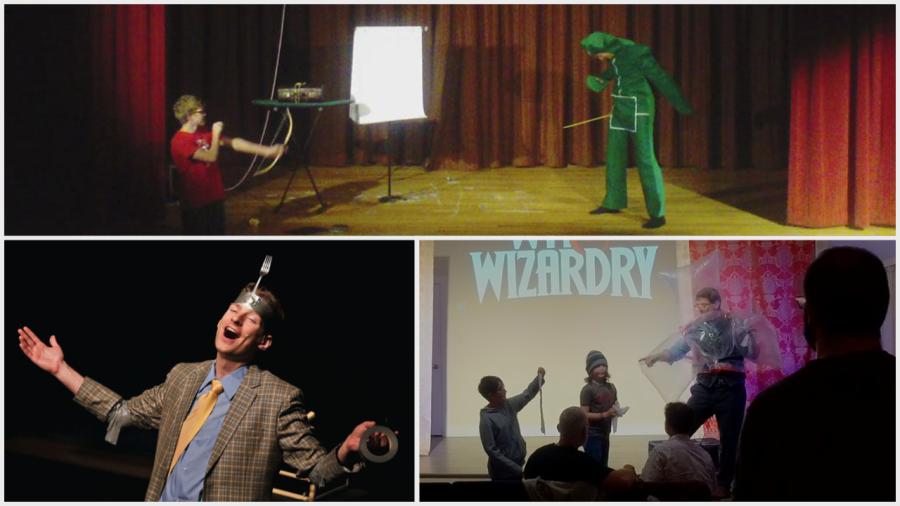
Then there was that one time I performed inside an inflated clear garbage-bag suit, a last minute decision because I thought I might have caught a cold, and didn't want to share it with my audience. It turned out to be so much fun, I'm still cooking up plans to use the gag again... without the viral infection part. These were all deliberate choices to do something... anything!... to step out of the ordinary magician stance, to break the conventions of normal human interactions. For me it has paid off in creating a remarkable performance... in that people did, and still do, remark upon it. Frankly, I think I've been slacking on this lately. I've been focusing so much on developing new routines I'm not getting to this fun, ridiculous, "next level" as often as I ought to. However, I stumbled upon some fresh inspiration this week which reminded me of the kind of unusual physicality I really want to bring to my shows. You do Fosse, Fosse, Fosse!I found a video of a modern jazz dance number... normally not something I seek out, but... this is the most captivating dance choreography I've ever seen. Compared to many production dance numbers caught on film, usually big, loud, athletic, and filled with stunts this one has a restrained minimalism about it, punctuated by the occasional outburst of activity. I find the whole thing consistently interesting. Here's a snapshot of some dancers entering the stage. It's just a visually interesting way to walk. Don't you think you might draw more attention and interest, pique curiosity, from your audiences if you entered the stage like this? 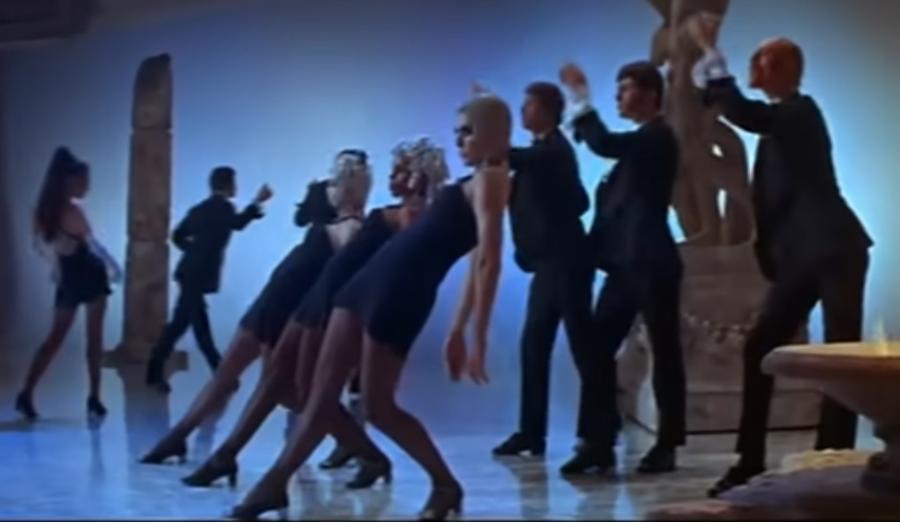
It reminds me of another exercize from my Drama class. These ladies are leading with thier toes when they walk. The gents are walking around leading with their wrists cocked forward. You can create different physical walks by choosing a specific body part and letting it lead the way. You would walk very different if you forced your elbows to enter the room before you. It would be rather distracting to walk this way all the time, but imagine if you were approaching a spectator to read their mind. This would be a great moment to have a peculiar walk, say, leading with your left shoulder. It would make that moment more fun, more mysterious, more interesting. I invite you to watch the entire dance number, choreographed by the legendary Bob Fosse for his movie Sweet Charity (1969). Watch on YouTube. You can pause it on any frame and find every single person in the shot standing in a visually interesting way. Don't you think your performance might be more fun to watch if you endeavoured to do the same? What would Bob Fosse suggest if he was directing your show? How would he have you walk across the stage to pick up the next prop? Magicians can be amazing every so often, and occasionally funny, but I think we should strive to be always interesting. -Ryan |